Quick answer: The Scoville scale measures how hot a chilli is in Scoville Heat Units (SHU), based on its capsaicin content. Invented in 1912 by the pharmacist Wilbur Scoville, it originally relied on a panel of tasters; a more precise laboratory method has taken over since the 1980s. A mild pepper sits at 0 SHU, the hottest go beyond a million.
Saying a chilli "is very hot" stays fairly vague. The Scoville scale gives a numerical reference for comparing the heat of two chillies, whether a mild variety or a very hot one. This page explains where this scale comes from, how it is measured, and why it remains, despite everything, an approximate measure.
Who invented the scale, and why
The scale owes its name to Wilbur Scoville, an American pharmacist who developed his method in 1912, while looking for a chilli suited to making a heating ointment. His process, known as the Scoville organoleptic test, rests on the taste of several people rather than on a measuring instrument, which makes it a scale that is both old and still used as a reference today.
The original test: a panel of tasters
The Scoville test consists of dissolving an exact weight of dried chilli in alcohol to extract the compounds responsible for the heat, the capsaicinoids. This extract is then diluted in sugar water, at decreasing concentrations, and given to a panel of five trained tasters to taste. The dilution continues until most of them, at least three out of five, no longer detect any heat. The result is expressed in multiples of 100 Scoville units. This method has a known limitation: it depends on each taster's perception, which varies with each person's sensitivity and palate fatigue over the course of the tastings, which makes results sometimes quite different from one laboratory to another.
The modern method: chromatography
Since the 1980s, a laboratory method called high-performance liquid chromatography has made it possible to measure directly the amount of capsaicinoids in a chilli, through chemical analysis rather than human taste. The result obtained is then converted into Scoville units, which gives a more reproducible measure than the 1912 test, even though the scale keeps its original name and unit.
A few reference points on the scale
To give an idea, here are a few commonly cited values, in Scoville Heat Units (SHU):
- Sweet pepper: 0 SHU.
- Jalapeño: about 2,500 to 10,000 SHU.
- Cayenne pepper: about 25,000 to 50,000 SHU.
- Habanero: about 100,000 to 350,000 SHU.
- Ghost pepper: about 750,000 to 1,500,000 SHU.
- Carolina Reaper, one of the hottest on record: about 1,500,000 to 2,500,000 SHU.
And our pili-pili chilli?
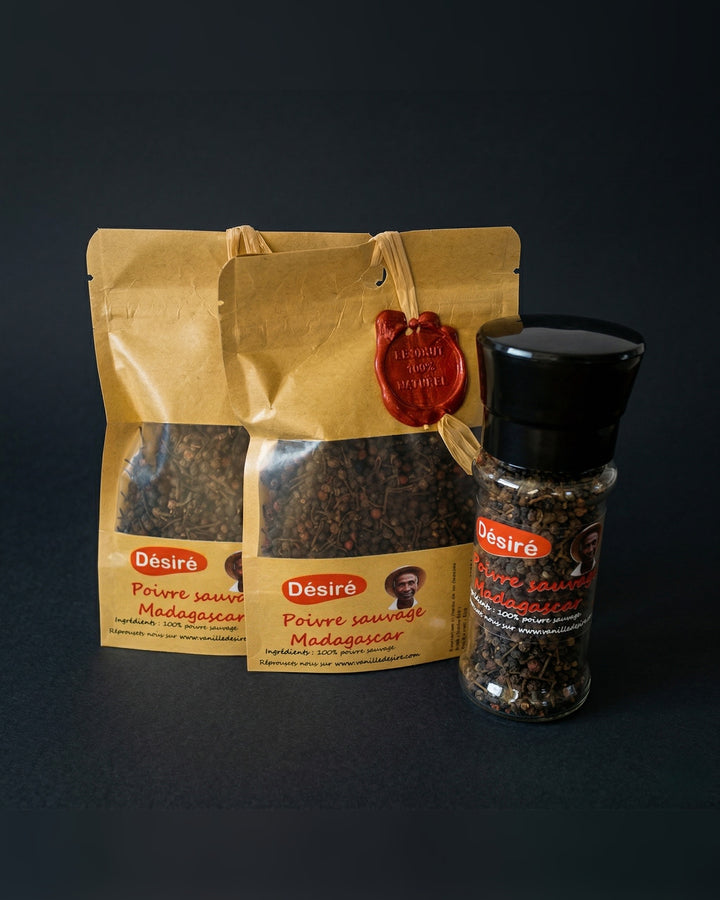
The name "pili-pili" comes from the Swahili pilipili, which simply means "chilli", a word found in several close forms (pili-pili, piri-piri, peri-peri) across a good part of Africa, used for small hot chillies, most often of the species Capsicum frutescens. One source places this chilli, under its piri-piri name, at between 50,000 and 175,000 SHU. This figure comes from a chilli studied elsewhere than in Madagascar: it is not a measurement taken on our own pili-pili chilli, prepared in Vangaindrano, in the southeast of Madagascar. In the absence of a measurement on our own chilli, we do not give it a figure on the Scoville scale. Our page on Madagascar pili-pili chilli describes this chilli without this figure.
Why two people do not feel the same heat
Beyond the laboratory measurement, sensitivity to capsaicin varies a great deal from one person to another, and even from one day to the next for the same person. This is exactly what made Scoville's original test sensitive to differences between tasters. In cooking, the best approach stays the same, whatever figure is printed on a packet: start with a small amount, taste, then adjust. Our pages on a dish that is too spicy and on dried chilli, whole or powdered set out this principle.
Our products
- See Madagascar pili-pili chilli (glass jar)
- See Madagascar pili-pili chilli (spice jar)
- See Madagascar chilli paste
Frequently asked questions
What does the Scoville scale measure?
It measures how hot a chilli is, linked to its capsaicin content, in Scoville Heat Units (SHU): the higher the figure, the hotter the chilli.
How did Wilbur Scoville measure heat in 1912?
With a taste test: a chilli extract was gradually diluted and given to a panel of five tasters, until most of them no longer detected any heat.
How hot is our pili-pili chilli on the Scoville scale?
We do not give a figure: one source places the piri-piri chilli, a close relative under a similar name, at between 50,000 and 175,000 SHU, but this value does not come from a measurement taken on our own Madagascar chilli.
Why do two people not feel the same heat from the same chilli?
Because sensitivity to capsaicin varies from one person to another, which also explains part of the subjectivity of Scoville's original test, based on the taste of a panel of tasters.
The Vanille Désiré team