Quick answer: Pink peppercorns and Sichuan pepper are two "false peppers": neither belongs to the botanical pepper family, the Piperaceae. Pink peppercorns come from a tree native to South America, Sichuan pepper from a shrub related to citrus fruits, native to China. Their taste has nothing in common: pink peppercorns are fruity and crunchy, Sichuan pepper tingles and slightly numbs the tongue.
The word "pepper" accompanies pink peppercorns as much as Sichuan pepper in everyday language, to the point of suggesting they belong to the same family as black, white or green pepper. Both are, however, what are called "false peppers": spices that borrow the pepper's name, and sometimes its use, without sharing its botanical origin. This page places each of the two, what sets them apart, and why they are still called "pepper".
Pink peppercorns, a fruit from South America
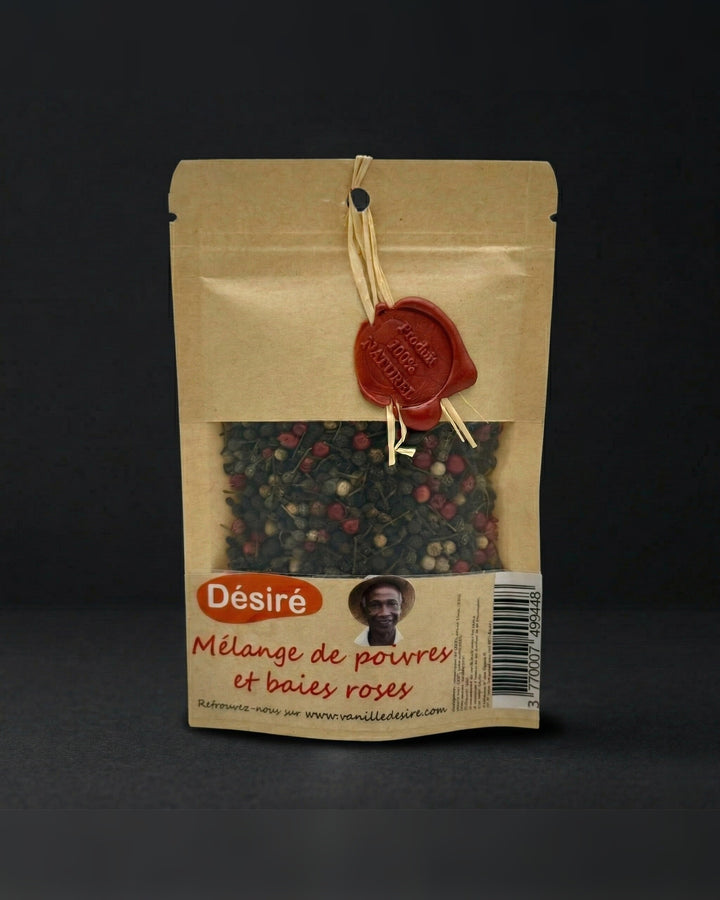
Pink peppercorns come from Schinus terebinthifolius, a tree native to South America, to Brazil and Peru, now grown in other tropical regions. It belongs to the Anacardiaceae family, that of the cashew, the mango or the pistachio, a family far removed from the pepper plant. The fruit is a small coral-red drupe about eight millimetres across, harvested and then dried whole, shell included. Our family grows its pink peppercorns in Vangaindrano, in south-eastern Madagascar.
Sichuan pepper, a cousin of citrus fruits
Sichuan pepper comes from shrubs of the genus Zanthoxylum, including Zanthoxylum simulans, native to the Chinese province of Sichuan and neighbouring regions. This plant belongs to the Rutaceae family, that of citrus fruits, also very different from the pepper plant. What is sold under the name "berry" or "grain" of Sichuan pepper is actually the dried husk of the fruit, smaller than the pink peppercorn, about four to five millimetres, harvested in small clusters. Vanille Désiré does not sell Sichuan pepper.
Two opposite effects in the mouth
The pink peppercorn is crunchy: its dried shell is thin and brittle, with a fruity, slightly sweet taste, and a peppery note at the finish. Sichuan pepper acts differently: it contains a compound, hydroxy-alpha-sanshool, which tingles and slightly numbs the tongue and lips, a little like a fizzy drink or the contact of an electric battery on the tongue. This tingling has no equivalent in the pink peppercorn. In Sichuan cuisine, this effect, combined with chilli, has a name, "mala", literally "numbing-spicy".
Telling them apart when buying
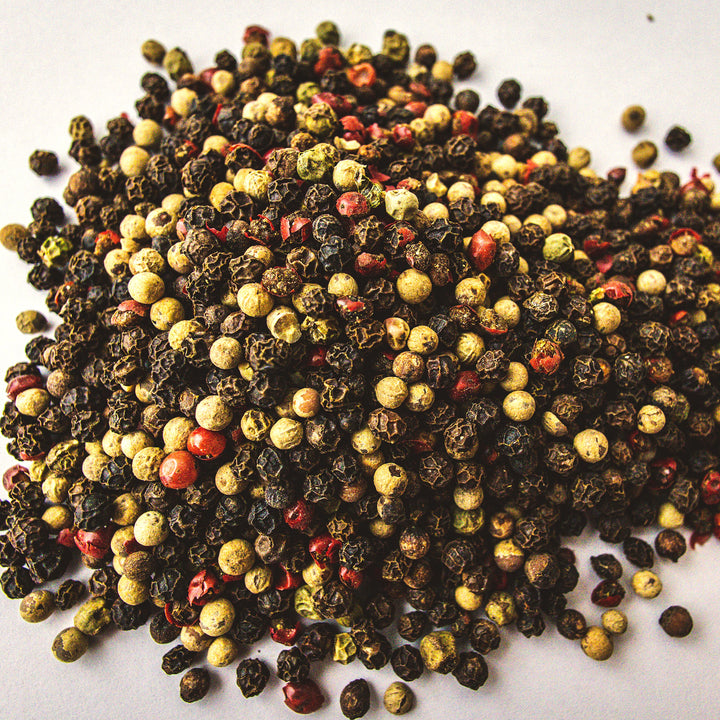
The pink peppercorn comes as a small, crinkled shell, coral red to brick red, larger than that of Sichuan pepper. Sichuan pepper comes as small brown or reddish husks, grouped in clusters: it is these husks, not the hard black seeds they originally contain, that carry the sought-after aroma and are sold once the seeds have been removed. Both are most often found whole, to be crushed just before serving to keep all their aroma.
Why they are called "pepper"
True pepper, black, white, green or wild, comes from a single botanical family, the Piperaceae, and the genus Piper. Pink peppercorns and Sichuan pepper were given the name "pepper" through a resemblance in shape or use, a small dried grain that seasons a dish at the end of cooking or at the table, not through any botanical kinship. It is a convention of language, not a scientific classification: the three Piperaceae in our range, black pepper, white pepper and wild Voatsiperifery pepper, therefore do not share the same family relationship with pink peppercorns or Sichuan pepper that they share with one another.
Which to use, and for what
Pink peppercorns are mainly used as a finishing touch: on a tartare, a carpaccio, a salad, a fruit dessert, wherever their crunch and fruitiness stay intact. Pink peppercorns in savoury cooking and pink peppercorns in desserts go into these uses in detail. Sichuan pepper, not sold by Vanille Désiré, remains associated with Chinese and Sichuanese cuisine, particularly dishes known for their "mala" effect. For the broader question of whether the pink peppercorn itself is a pepper, see pink peppercorns, a pepper or not.
Our Madagascar pink peppercorns
Our family grows these pink peppercorns in Vangaindrano, in south-eastern Madagascar, then dries them whole, shell included.
Frequently asked questions
Are pink peppercorns a true pepper?
No: they come from Schinus terebinthifolius, a South American tree of the Anacardiaceae family, with no botanical link to the pepper plant, which belongs to the Piperaceae.
Does Vanille Désiré sell Sichuan pepper?
No. Our pepper range includes black pepper, white pepper, green pepper and wild Voatsiperifery pepper, all from the Piperaceae family; Sichuan pepper, from a different family, is not part of it.
Can pink peppercorns be replaced with Sichuan pepper in a recipe?
The two have very different effects in the mouth: the pink peppercorn is fruity and crunchy, Sichuan pepper tingles and slightly numbs the tongue. Substituting one for the other therefore clearly changes the result.
Where do Vanille Désiré's pink peppercorns come from?
Our family grows them in Vangaindrano, in south-eastern Madagascar, then dries them whole.
The Vanille Désiré team